Horse Boost Official Website › Blog › What 82 Milligrams Actually Buys: Reading The Horse Boost Blend Row
From the deskWhat 82 Milligrams Actually Buys: Reading The Horse Boost Blend Row
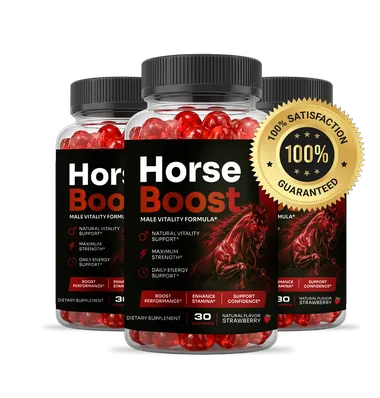
Horse Boost has one active row on its panel: a proprietary blend of 82 mg carrying nine ingredients.
Only the caffeine has a figure of its own. This post does the arithmetic out loud: the best-case split, the multiples against every published trial dose, what the dry-powder footnote adds, and why the answer is not quite a scandal.
The one row that decides everything
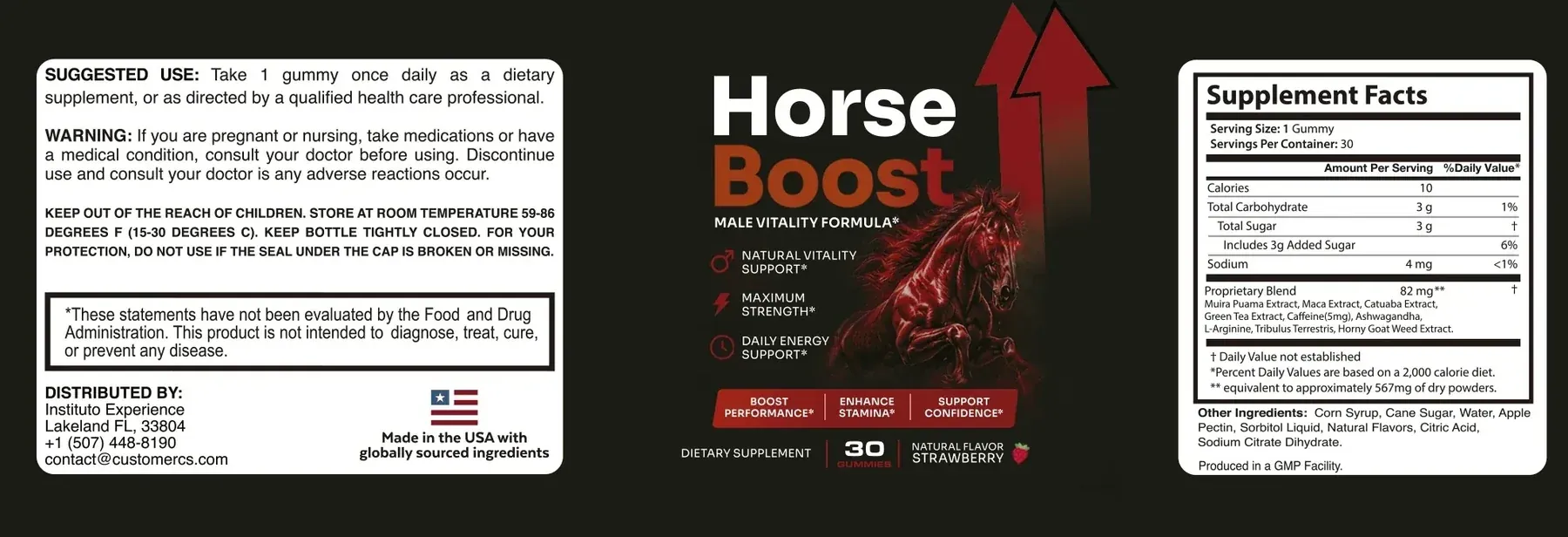
Turn a Horse Boost bottle over and the Supplement Facts panel has five rows on it. Four are nutrition: calories, carbohydrate, sugars, sodium. The fifth is the entire active side of the product, and it reads: Proprietary Blend, 82 mg.
Underneath it, nine names. Muira puama extract, maca extract, catuaba extract, green tea extract, caffeine at five milligrams, ashwagandha, L-arginine, tribulus terrestris and horny goat weed extract. One figure, nine ingredients, and a footnote.
Everything this website can honestly say about the product is decided by that row, so this post does the arithmetic in public rather than asserting a conclusion.
What a proprietary blend is, legally
A proprietary blend lets a manufacturer group several ingredients under a single total and decline to publish the split between them. It is legal, it is extremely common across the supplement shelf, and the usual reaction to it online is that it exists to hide small doses.
That reaction is often right and it is not the whole picture. Two things are worth separating. The first is that a blend total is still a real number produced under the same labelling rules as any other, and the manufacturer is answerable for it. The second is that a total functions as a ceiling: nothing inside the blend can weigh more than the blend does.
So the question is never whether a blend is disclosed. It is whether the ceiling is high enough to matter.
The best-case arithmetic, done out loud
Start with the eighty-two milligrams. Subtract the one ingredient that carries a figure of its own, the caffeine at five milligrams, and seventy-seven milligrams remain for eight ingredients.
Divide seventy-seven by eight and the answer is a shade over nine and a half milligrams each. That is the even-split case, and the manufacturer has not promised an even split. The real distribution could be seventy milligrams of one ingredient and a milligram each of the rest; nothing on the panel rules it out.
What the even-split figure gives is a reference point, and a more useful one than it first looks. If a reader wants to ask whether any single ingredient could be at a studied dose, the ceiling answers it directly: the largest any one of them can be is seventy-seven milligrams, and that would mean the other seven are essentially absent.
| Scenario | Largest possible single ingredient | What it would imply |
|---|---|---|
| Even split across the eight | ~9.6 mg each | Every ingredient is at a small fraction of any studied dose |
| One ingredient favoured, rest token | up to 77 mg | Seven of the nine names are on the label for the label's sake |
| Two favoured, six token | up to ~38 mg each | Still well under the smallest studied dose of anything on the row |
| Any scenario at all | never more than 82 mg | The ceiling holds regardless of how the split falls |
This is the whole value of a blend total: the last row is true no matter what the manufacturer did.
What that best case looks like beside the trials
The comparison is the point, and it is arithmetic rather than opinion. Here is each ingredient beside the dose used in the published research.
| Ingredient | What the trials used | Multiple of the whole 82 mg blend |
|---|---|---|
| Maca | 1,500–3,000 mg a day | 18x to 37x |
| L-arginine | 5,000 mg a day | 61x |
| Tribulus terrestris | 800 mg a day | 10x |
| Horny goat weed | 370–1,110 mg single dose | 4.5x to 13.5x |
| Ashwagandha | 240–675 mg a day | 3x to 8x |
| Green tea catechins | hundreds of mg a day | several times over |
| Caffeine | up to 400 mg a day is the reviewed adult figure | the panel's 5 mg is 1/80th of it |
| Muira puama | no controlled trial in men exists | not applicable |
| Catuaba | no controlled human trial exists | not applicable |
Multiples are against the entire blend, not against one ingredient's share of it, which makes them the most favourable version of the comparison.
The smallest positive single-ingredient dose anywhere in that table is 240 mg of a standardised ashwagandha extract, from the 240 mg ashwagandha stress trial. Three times the whole blend, before the other eight names take a share.
That is the honest arithmetic and there is no way to soften it. The ingredients page works through each row with its trial linked.
Order Horse Boost with the arithmetic done
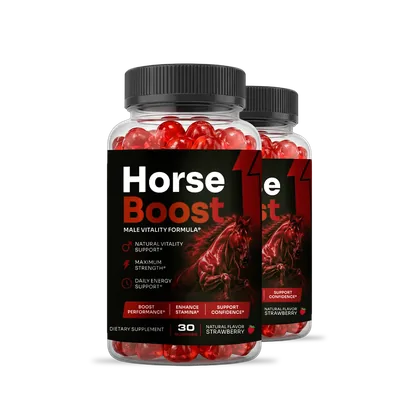
Eighty-two milligrams across nine names, printed on the panel and worked through above. Sixty days from purchase to decide whether the routine is worth it.
Two bottles $158 · six bottles $294 · 60 days from purchase
Order Horse Boost On The Official WebsiteOne gummy a day · 30 to a bottle · lot HOR-26/HO-6816
The footnote that gives the row a second number
There is one more number, and it is easy to read past. Under the panel sits a double dagger: equivalent to approximately 567 mg of dry powders.
Divide 567 by 82 and the answer is a shade under seven. So the extracts on this row average roughly a seven-to-one concentration, meaning the eighty-two milligrams represents somewhere near five hundred and sixty-seven milligrams of raw plant material before extraction.
Two caveats matter. It is an average across eight different plants, not a ratio for any one of them, so it cannot be turned into a per-ingredient figure. And no row carries a standardisation marker, so there is no way to tie the ratio to a specific constituent. What it does is put a bound on the raw material behind the row, which is more than a bare 82 mg would give anybody.
It is also, quietly, the most transparent thing on the panel. A great many blend rows carry no footnote at all.
Why this is not automatically a scandal
It would be easy to end this post at the multiplication table, and it would be a half-truth. Three things belong beside it.
- Everything else on this label is printed. The sugar, separately as total and as added. The calories. The sodium. The caffeine, in brackets, at a level nobody would have been embarrassed to hide. The storage range, the seal instruction and a distributor with its own address, phone number and mailbox.
- The ceiling is genuinely usable. A reader can do the arithmetic above in thirty seconds and reach a defensible conclusion. That is not true of a panel with no total at all.
- A routine is not worthless. A chewable a man in his fifties actually takes for two months has a value that a clinical dose nobody swallows does not, and adherence is the single most common reason supplement purchases fail.
The category-level reviews reach the same place from the other direction. the evidence review of ingredients in popular men's supplements and the analysis of what marketed products actually contain both find that marketed products in this category routinely carry ingredients at fractions of their studied doses. Horse Boost is not an outlier; it is the shelf.
What a buyer should actually do with this
Not much, and specifically: decide what you are buying before you pay rather than after.
- If you are buying a trial result in a bottle, the arithmetic above says you will not get one, and no amount of reading the front panel changes that.
- If you are buying a pleasant daily routine with a small botanical input and a sixty-day way out, that is a coherent purchase and the price per day is competitive.
- If you want disclosed doses, the category does contain fully disclosed panels, and the method for finding one is on this site.
- If you take a nitrate or a prescription for erectile difficulty, the dose question is not your question. The side effects page is.
The thirty-second test generalises: blend total, divided by the number of names, compared with the smallest studied dose of anything on the row. Carry that to any bottle on any shelf and it will settle most of the question before you have read a word of the marketing.
The honest reading
Eighty-two milligrams across nine names, with one of them accounting for five of those milligrams, is a small blend by any measure and a very small one against the research behind its own ingredients. That is the finding and there is no version of it that flatters the product.
What the panel does well is everything else. It prints what it could have hidden, it gives a ceiling a reader can work with, and it adds a footnote that most blend rows omit. One omission is not a pattern.
Buy it as a routine, judge it over sixty days, and keep the purchase date. That is the conclusion the arithmetic supports, and it is the only one this desk is prepared to print.
The thirty-second test, for any bottle on any shelf
The most useful thing in this post is not the conclusion about Horse Boost. It is the method, which takes half a minute and works on anything.
Find the active rows. If every ingredient carries an amount, compare the two or three you care about with the published trials. If several sit under one blend total, take that total, count the names beneath it, and divide. Then compare the answer with the smallest dose that has ever worked in a trial of anything on the row.
Three outcomes, and each one tells you what kind of product you are looking at. A best case in the same order of magnitude as a studied dose is a product that could plausibly do what it says. A best case at a tenth of it is a routine, which may still be worth buying and should be bought as one. A panel with no totals at all is not a Supplement Facts panel and the bottle should go back on the shelf.
The full version of that method, including the seals, the seller and the return window, is on the choosing a formula page. It is deliberately written so that applying it to this bottle produces an honest failure on the second check, which is the only test of a buying guide published by a seller.
Sources
- Lopresti AL, Smith SJ, Malvi H, Kodgule R. An investigation into the stress-relieving and pharmacological actions of an ashwagandha (Withania somnifera) extract: A randomized, double-blind, placebo-controlled study. Medicine (Baltimore). 2019;98(37):e17186. doi:10.1097/MD.0000000000017186. PMID 31517876. https://pubmed.ncbi.nlm.nih.gov/31517876/
- Gonzales GF, Córdova A, Vega K, et al. Effect of Lepidium meyenii (MACA) on sexual desire and its absent relationship with serum testosterone levels in adult healthy men. Andrologia. 2002;34(6):367-72. doi:10.1046/j.1439-0272.2002.00519.x. PMID 12472620. https://pubmed.ncbi.nlm.nih.gov/12472620/
- Chen J, Wollman Y, Chernichovsky T, Iaina A, Sofer M, Matzkin H. Effect of oral administration of high-dose nitric oxide donor L-arginine in men with organic erectile dysfunction: results of a double-blind, randomized, placebo-controlled study. BJU Int. 1999;83(3):269-73. doi:10.1046/j.1464-410x.1999.00906.x. PMID 10233492. https://pubmed.ncbi.nlm.nih.gov/10233492/
- Santos CA, Reis LO, Destro-Saade R, Luiza-Reis A, Fregonesi A. Tribulus terrestris versus placebo in the treatment of erectile dysfunction: A prospective, randomized, double blind study. Actas Urol Esp. 2014;38(4):244-8. doi:10.1016/j.acuro.2013.09.014. PMID 24630840. https://pubmed.ncbi.nlm.nih.gov/24630840/
- Teo YL, Cheong WF, Cazenave-Gassiot A, et al. Pharmacokinetics of Prenylflavonoids following Oral Ingestion of Standardized Epimedium Extract in Humans. Planta Med. 2019;85(4):347-355. doi:10.1055/a-0806-7673. PMID 30522143. https://pubmed.ncbi.nlm.nih.gov/30522143/
- Nawrot P, Jordan S, Eastwood J, Rotstein J, Hugenholtz A, Feeley M. Effects of caffeine on human health. Food Addit Contam. 2003;20(1):1-30. doi:10.1080/0265203021000007840. PMID 12519715. https://pubmed.ncbi.nlm.nih.gov/12519715/
- Kuchakulla M, Narasimman M, Soni Y, Leong JY, Patel P, Ramasamy R. A systematic review and evidence-based analysis of ingredients in popular male testosterone and erectile dysfunction supplements. Int J Impot Res. 2021;33(3):311-317. doi:10.1038/s41443-020-0285-x. PMID 32358510. https://pubmed.ncbi.nlm.nih.gov/32358510/
- Petre GC, Francini-Pesenti F, Vitagliano A, Grande G, Ferlin A, Garolla A. Dietary Supplements for Erectile Dysfunction: Analysis of Marketed Products, Systematic Review, Meta-Analysis and Rational Use. Nutrients. 2023;15(17). doi:10.3390/nu15173677. PMID 37686709. https://pubmed.ncbi.nlm.nih.gov/37686709/